



You know it costs more to attract a new client or patient than it does to keep your existing ones.
But do you know exactly how much? According to a Harvard Business Review article, replacing a client can cost up to 25 times more than it does to keep an existing client.
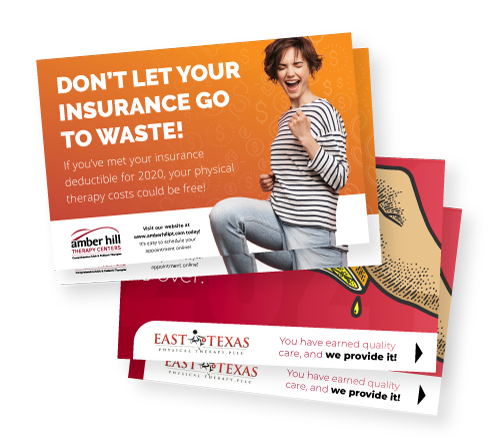
Fortunately, sending out direct mail pieces, like postcards, newsletters, and welcome packets can be just the tools you need to bring your former patients back into your clinic. The right physical therapy direct mail piece can also motivate more doctors to send clients your way. All in all, it’s a good marketing method for your practice to adopt.
In this blog post, we’re going to talk about…
- What types of physiotherapy direct mail you should create for each audience
- How to get your direct mail campaign started
- The types of information to include in each mail piece
- What to do if you don’t have a writer or designer
Let’s get started!

What Kinds of Direct Mail Pieces Should I Send?
Direct Mail to Physical Therapy Patients
- Patient newsletters: Ideally, you should be in regular contact with both your past and present clients. Some of our clients report that their appointment numbers crash when they stop sending out direct mailers like newsletters to their physical therapy clients. Newsletters have a number of advantages. They allow you to give your clients news updates about your practice, including new services or classes. They also give you the opportunity to offer wellness tips and tricks, inspirational quotes, and other materials that your clients find useful.
- Postcards: Postcards can serve a couple of purposes. They can be abbreviated versions of your newsletters. Just add a few quick lines and go. Oversized postcards work well for this. They’re also ideal for special promotions, like free health screenings a couple of times a year. These usually bring people back into the office.
- Letters: Sending out letters offers you a format in which you can send longer forms of communication to a patient. Send these when you’re looking for a more formal way to approach past clients.
Direct Mail to Doctors
- Physician mailers: There is a broad range of branded materials that doctors can send out in physician mailers. A logical mailer to send out is a variation of the new patient welcome pack. Physical therapists can send out a physical therapist introduction package to introduce themselves and their services to doctors they haven’t worked with before.
- Letters: Like the letters that physical therapists send to their clients, the letters physical therapists send to doctors offer them a longer form of communication. They can be regular newsletters or specialty letters. For example, if the physical therapist met a doctor at a professional meet-and-greet and picked up the physician’s business card, the PT can then follow up the meeting with a more formal letter of introduction, asking the doctor for his or her business.
Tips to Get Your Physical Therapy Direct Mail Campaign Started

1. Create Your Physiotherapy Direct Mail Offer
When you’re creating a new direct mail offer, it’s best to come up with an icebreaker of sorts. That is, you need a reason to be reaching out to new doctors or to your past clients, particularly if you haven’t spoken to them in a while.
While it’s perfectly acceptable to send “just because” direct mail postcards to your past clients, you really want to go into this campaign with a purpose in mind. Ask yourself what you want your past clients to DO as a result of your campaign.
For example, do you want your rehab therapy direct mail piece to encourage them to come in for a free screening? Or would you like to get more doctors to refer patients to you?
Once you know this, you can decide when you want to send out your physical therapy direct mail piece. For example, maybe you want it to go out with your end-of-the-year patient newsletters, with the intention that people will start the new year with a free screening.
2. Assemble a List for Your Occupational Therapy Direct Mail
Once you’ve decided on the purpose of your physical therapy direct mail campaign, it’s time to assemble a list of people that you’ll send the piece to. That’s why it’s critical to decide ahead of time what you want your campaign to be about. If you know what the goals of your campaign are, then you also know which audience would appreciate your offer.
Here’s an example. Let’s say that your physical therapy practice offers a vegan cooking class once or twice a month. (It’s part of a complimentary healthy lifestyle series you have in conjunction with your other services.) Let’s also say that your physiotherapy direct mail campaign is directed at getting more people to attend this class.
Therefore, the people who need to be on the list of recipients for this direct mail piece are people who are interested in vegetarian or vegan cooking. These people are most likely to respond to your campaign.
3. Write and Design Your Direct Mail Item
The human brain is made for images, much more than any other kind of sensory input. According to Social Media Today, the human brain will process visual stimuli 60K times faster than it will text alone.
Studies have also proven that adding relevant images to your brochures, websites, social media posts, etc. allows people to retain at least 65% of the information in the campaign.
In other words, you need visual imagery in your direct mail pieces to create the kind of impact that you want. For this, it’s best to hire a graphic designer if you don’t already have one in-house. Don’t underestimate how important this is.
Many people erroneously assume that anyone can create beautiful and effective graphic design, but that just isn’t the case. Poorly designed physical and occupational therapy direct mail pieces and brochures reflect poorly on your business and have the opposite effect.

4. Print and Mail Your Postcards
Once your direct mail piece is designed, it’s time to look for a printer. Businesses like Mail.com, ITI, and Vistaprint all offer printing services as do we.
You’ll need to instruct your graphic designers to submit files for printing. Many printing services prefer PDFs or PNG files. For the least hassle, it’s best to have your graphic designer communicate directly with the printer.
Eventually, you should get a proof back from the printer. A proof is a sample that allows you to see what the final product will look like. So, if you’ve ordered a postcard, then you’ll get a sample postcard with your design on it. Check for any misspellings and mistakes. You also want to check to see how the design looks.
If you have changes to make to the design, make them and then send the new digital files to the printer. Repeat the process until you get a proof you like. Once you decide on a final proof, order your postcards and mail them out.
5. Measure the Results of Your Physiotherapy Direct Mail Piece
Creating and sending out your direct mail represents only one side of the coin. You need to know if it is an effective marketing piece. In order to determine this, you’ll need to add something to the piece to allow you to measure its effectiveness.
In other words, are people contacting you because they received your direct mail piece? Or is there another reason why so many people are calling your physical or occupational therapy business?
A couple of methods work to reveal the nature of the calls you’re receiving.
First, you can create a special phone number and put it on your postcards, newsletters, and other direct mail pieces. The only people who have that phone number should be the people who received your direct mail piece. Track the number of calls you get on that phone number.
Another alternative to this is to put a special code on the mailer. When people call in, you can ask them how they heard about you. If they give you the code, then you know they’re responding to the direct mailer. The same holds true if the call-to-action on your mailer asks people to bring the postcard to the office with them. You can track the response that way, too.
Second, if you get an uptick in reactivated patient numbers or doctor referrals after you send out the physiotherapy direct mail piece, then there’s a good chance these are coming from your mailer campaign.
Third, compare your original list of recipients with the names of the responders. You should see a strong correlation between the list and the people who responded to the offer.

What Kinds of Direct Mail Campaigns Attract New Patients?
When you’re creating your direct mail campaigns, some approaches and techniques work better than others. In our experience, there are a few specific elements that significantly improve the chance of your physical therapy and rehab therapy direct mail campaign being a success.
1. Create a Sense of Fun or Add Humor
Let’s face it. Life for most people gets pretty dreary at times, and much of marketing today uses gloom and doom to “motivate” people to act. Lots of healthcare professionals capitalize on people’s fears.
That may work for some, but according to Forbes, using humor in your marketing makes your brand more relatable, as well as making you seem more human and trustworthy. Humor and fun in marketing also lead to higher recall. That’s good! You want people to remember your ad or marketing collateral, like a postcard.
2. Tell Them How You Can Help
Nowadays, everyone, patients and physicians alike, get bombarded with stuff. As such, they don’t have the bandwidth to wade through a bunch of fluff. When you’re writing your direct mail piece, be sure to tell them early on how you can help them.
For example, if your physical therapy practice centers around helping athletes to recover from injuries, let them know that.
3. Create a Strong Call-to-Action (CTA)
All the work you put into your direct mail piece will be for naught if you don’t put a call-to-action at the end of the piece. The CTA can be a request for them to come in for a free screening, to get them to take a class of yours, or to make a follow-up appointment.
A piece of direct mail without a CTA might as well be a just-saying-hello postcard. You want it to increase your business in some way, so don’t forget to add it at the end and even throughout the document.
What If I Don’t Have a Writer/ Designer or the Time to Create This?
Lots of small business owners, including physical therapists, try to create marketing collateral themselves. The problem is, that’s not their area of expertise. Not surprisingly, they get poor results from their efforts.
That’s when it’s wise to turn to a full-service design-to-print service… More specifically, one that specializes in physical therapy marketing materials. Such a service can produce professional-looking mailers that include text that packs a punch.
Keys to Remember
Sending out mailers can make a huge difference in your physical therapy practice. They can even be the difference that keeps your business afloat during challenging times. When a patient or doctors receive your direct mail piece, they’re receiving a bit of you in their mailbox. Make sure you give them the right impression.